Modernise with purpose. Protect useful investment.
A control system should meet the customer’s needs. APControl is designed to adapt to the operation, its equipment and its priorities, while creating a consistent foundation for future development.
FINANCIAL
Invest where it makes a difference.
Retain functioning PLC systems where technically appropriate.
Phase investment around need, budget and production windows.
Reuse engineering modules and interface conventions.
Plan recovery and support as part of the investment.
TECHNICAL
Build a platform that can evolve.
Combine suitable existing and new PLC platforms.
Use a common Ignition-based HMI and SCADA approach.
Connect diagnostics, reporting and AI integration coherently.
Develop proprietary modules around the application.
OPERATIONAL
Make the plant easier to understand.
Give teams consistent screens and terminology.
Investigate faults using event history and process context.
Prepare operators through simulation and training.
Scale agreed conventions across multiple sites.
Designed around your operation. Developed around your requirements. Modernised at a pace that makes sense for your business.
YOUR PLANT. YOUR PACE.
Choose the right route to modernisation.
A modern operator experience does not have to begin with replacing every controller. We assess the plant, its risks and the required functionality before defining the migration.
Retain what works.
Bring a common HMI, visibility and diagnostic approach to suitable existing control systems. Confirm access, communications and control boundaries before implementation.
Modernise in planned stages.
Retain appropriate legacy controls while introducing new control modules where they deliver value. Define the interfaces, responsibilities and commissioning sequence.
Start with a flexible foundation.
Select an appropriate new PLC platform and configure APControl around the equipment, operator workflows and future reporting and optimisation requirements.
Integration is assessed for the specific controller, firmware, licensing and site requirements.
Compatible integration approaches are assessed per application. Product names identify potential technologies, not manufacturer endorsement, certification or universal compatibility.
A COMMON PLATFORM, CONFIGURED FOR YOU
Control. Diagnose. Optimise. Connect.
Select the functions your plant needs. Proprietary, reusable modules provide an engineering foundation; the final scope is tailored, tested and commissioned for the application.
A consistent operator experience
Common Ignition-based HMI and SCADA conventions bring plant status, operating modes, alarms and approved engineering functions into a familiar environment.
Bespoke modular control
Reusable functional modules are configured for the equipment and operating requirements. Standardisation supports repeatable development without treating every plant as identical.
Diagnostics with context
Actionable alarms, event sequences and process trends help engineers investigate what changed and why. The aim is to make fault investigation more informed and repeatable.
AI-ready, with defined authority
AI integration is considered as part of the control approach. Project-defined modes, limits, validation and fallback preserve the required conventional control behaviour.
Secure remote support & visibility
Authorised access can support monitoring, investigation and role-appropriate business views, subject to the customer’s network design, security policy and support agreement.
Resilience and recovery
Controlled versions, standardised backups, configuration records and recovery planning help a commissioned system remain supportable through its operating life.
THE OPERATOR EXPERIENCE
The whole plant. The detail that matters.
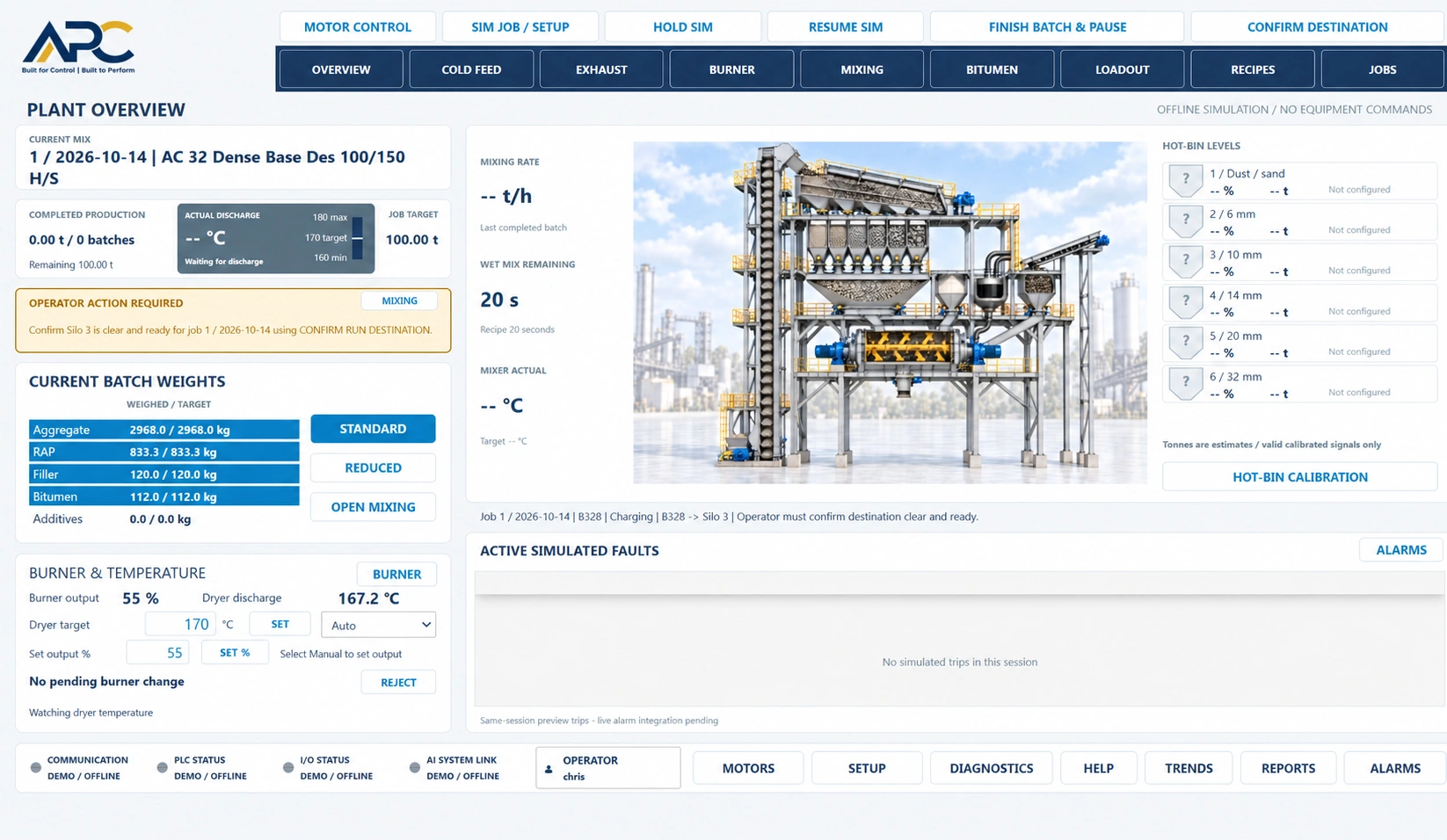
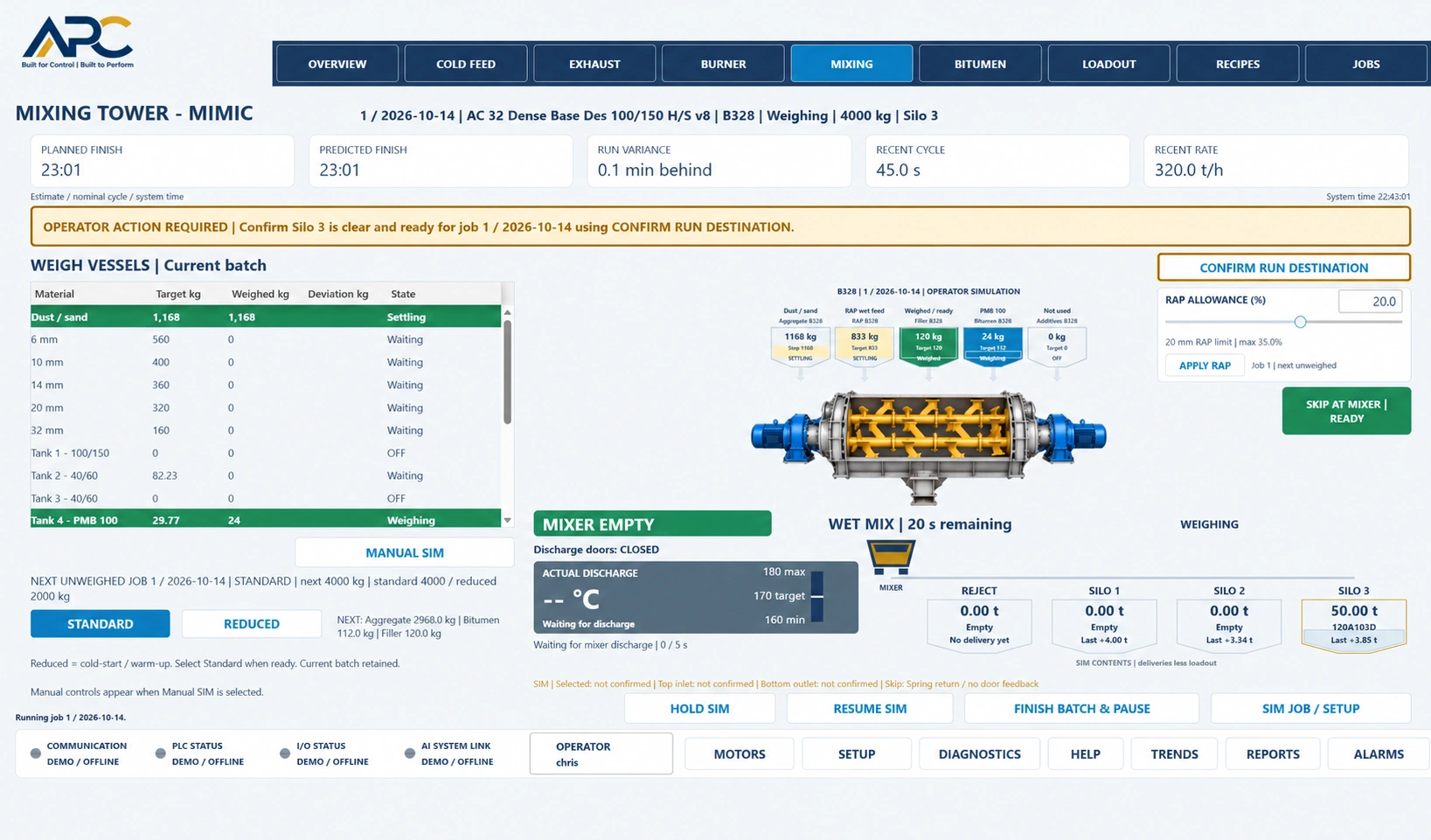
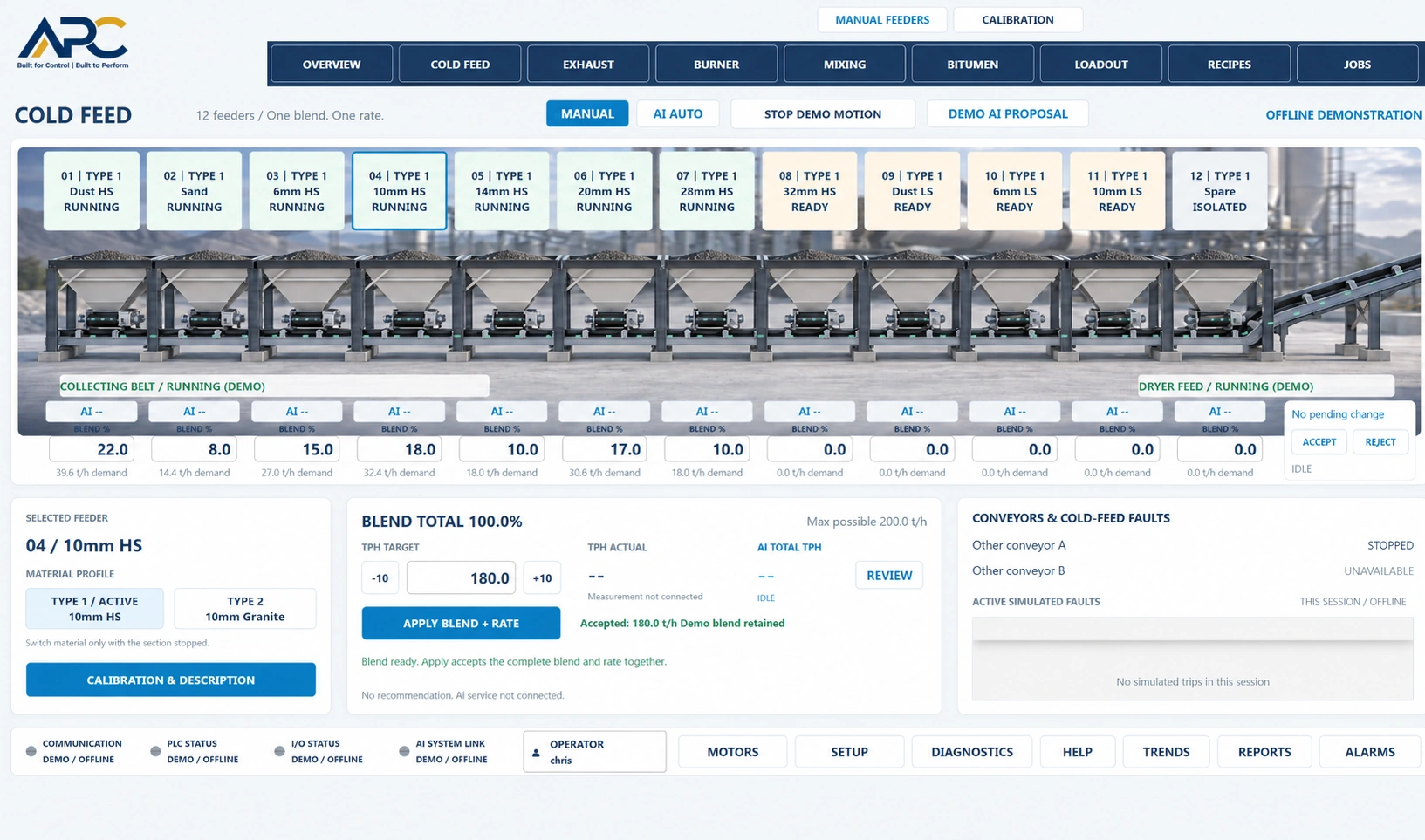
Explore the newer plant overview, mixing and cold-feed development screens. Clear process graphics, operator prompts and simulation workflows bring context to the controls. Values shown are illustrative.
Plant overview
One view of the production context: the current mix, batch weights, temperature information, operator actions and simulated fault status.
Promotional edit of an offline development screenshot. Demonstration values are not achieved plant-performance figures. Select the image to enlarge.
Mixing control
Follow the batch from weigh vessels through mixing and destination confirmation. Simulation controls support development and operator familiarisation.
Promotional edit of an offline development screenshot. Demonstration values are not achieved plant-performance figures. Select the image to enlarge.
Cold feed & AI workflow
A common view of feeder status, blend and rate. The demonstrated AI workflow includes review, accept and reject controls; the screenshot explicitly shows the AI service is not connected.
Promotional edit of an offline development screenshot. Demonstration values are not achieved plant-performance figures. Select the image to enlarge.
PRODUCTION REPORTING & EMBEDDED AI BEHAVIOUR
See what happened. Understand what matters.
The value of plant data is in the decisions it enables. APControl’s reporting approach connects production, materials and process behaviour with the context behind performance.
Production & materials
Products, batches, material usage and operating context.
Process & energy
Relevant temperatures, operating modes and energy data.
Events & constraints
Alarms, changes and the sequence around a stoppage.
AI behaviour
Recommendations, accepted actions and fallback events.
APControl
ENGINEERED BY APC
Your plant. One familiar experience.
Existing PLCMixed systemsNew PLC
One operator experience
Clear plant visibility
Actionable diagnostics
Production intelligence
Recovery confidence
Platform overview · capabilities configured to the agreed project scope
Reporting and AI functions are specified for each project and depend on available plant signals, integration and agreed validation. Cycle-time benchmarking and predictive functions form part of the continuing development direction where not included in a commissioned scope.
AI intelligence belongs within the operating discipline of the plant. Conventional control authority, agreed limits and a defined fallback remain fundamental.
SIMULATION, TRAINING & DEVELOPMENT
Build confidence before live production.
Simulation creates a controlled space to develop the system and prepare the people who use it. Operators can become familiar with screens, modes, alarms and fault responses without practising on a running plant.
For engineers, simulated I/O and process behaviour support functional testing, failure scenarios and factory acceptance testing before site commissioning.
Rehearse. Test. Learn.
Operator familiarisation and scenario-based learning
Engineering development and functional checks
Alarm, interlock and communications-loss scenarios
Commissioning rehearsal and acceptance evidence
Simulation and training environments are configured to the agreed project scope. They support, rather than replace, on-site validation.
CLEAR SCOPE. HONEST EXPECTATIONS.
Specify the capability. Verify the delivery.
APControl is a configurable engineering platform. A description on this website is not a promise that every function is included, universally compatible or commissioned on every plant.
Engineering services
Available for project discussion
Consultancy, control-system development, HMI/SCADA, diagnostics, integration, reporting, simulation, training and resilience planning. The proposed scope and delivery programme follow an engineering assessment.
Project-specific platform
APControl capabilities
Modules, integrations, AI behaviour, reporting and remote access are demonstrated and confirmed for the application before contractual commitment. Development or integration work is identified explicitly in the proposal.
Continuing development
Extending intelligence
Further cycle-time and recipe benchmarking, predictive maintenance and wider connected engineering functions are development directions. Availability depends on the validated release and agreed project scope.
Exploratory concept
Gizmo Vision / APControl Vision
Future hands-free industrial support is an exploratory concept. It is not an available commercial product or an announced third-party partnership.
PRACTICAL QUESTIONS
Start with the right questions.
Do we have to replace the existing PLC?
Not automatically. We first assess the controller, access, communications, operating risks and required functions. Retaining a working PLC may be appropriate; a planned hybrid or replacement route may be better in other cases.
Is APControl tied to one manufacturer?
No. APC selects suitable control platforms and integration methods for the application. Compatibility is assessed against the specific hardware, firmware, protocols, licensing and permitted access.
Can the system support more than one site?
APControl is designed around reusable modules and common operating conventions. Multi-site reporting and deployment are scoped around connectivity, data definitions, access permissions and the needs of each location.
How do you protect production during a change?
The project plan defines backups, testing, acceptance criteria, commissioning windows and a recovery route. Simulation can move part of the validation away from live production, with on-site checks still required.
Does AI replace the conventional control system?
The intended approach keeps defined control authority and operating limits in place. AI recommendations or actions are integrated through agreed interfaces and validated behaviour, including the response when AI is unavailable.
YOUR NEXT STEP
Modernise what matters. Keep what works.
Let’s start with your operation, your challenges and what you want to achieve.